Childlike Obedience
A Childlike Trust In God

To the early Christian, trusting God meant more than a teary-eyed testimony about “the time I came to trust the Lord.” It meant believing that even if obedience to God entailed great suffering, God was trustworthy to bring a person through it.
“A person who does not do what God has commanded shows he really does not believe God,”14 Clement declared. To the early Christians, to claim to trust God while refusing to obey Him was a contradiction (1 John 2:4). Their Christianity was more than verbal. As one early Christian expressed it, “We don’t speak great things—we live them!”15
One distinguishing mark of the early Christians was their childlike, literal obedience to the teachings of Jesus and the apostles. They didn’t feel they had to understand the reason for a commandment before they would obey it. They just trusted that God’s way was always the best way. Clement asked, “Who then is so irreverent as to disbelieve God, and to demand explanations from God as from men?”16
They trusted God because they lived in awe of His majesty and wisdom. Felix, a Christian lawyer in Rome and a contemporary of Tertullian, put it this way: “God is greater than all our perceptions—He is infinite, immense. Only He truly understands His true greatness; our hearts are too limited to really understand Him. We are making a worthy estimation of Him when we say that He is beyond estimation.... Anyone who thinks he knows the magnitude of God, diminishes His greatness.”17
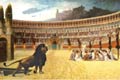
The supreme example of their absolute trust in God was their acceptance of persecution. From the time of the Emperor Trajan (around A.D. 100) until the Edict of Milan was issued in 313, the practice of Christianity was illegal within the boundaries of the Roman Empire. Being a Christian was a crime punishable by death. But the Roman officials didn’t generally hunt out Christians. They ignored them unless someone formally accused a person of being a Christian. As a result, persecution was intermittent. Christians in one town would suffer horrible tortures and death while Christians in a nearby area would be untouched. It was totally unpredictable. Yet, every Christian lived daily with a death sentence hanging over his head.
The very fact that Christians were willing to suffer unspeakable horrors and to die rather than disown their God was, next to their lifestyle, their single most effective evangelistic tool. Few, if any, Romans would die for their gods. There had to be some substance to Christianity if it meant so much to those who practiced it. In fact, the Greek word for “witness” is martyr. Not surprisingly, this is also the Greek word for “martyr.” In many places where our Bibles use the word “witness,” the early Christians were reading “martyr.” For example, in our Bibles, Revelation 2:13 refers to “Antipas, my faithful witness, who was put to death in your city.” The early Christians were understanding the passage to say, “Antipas, my faithful martyr.” Although most Christians tried to flee local persecution when possible, they rejected any mass exodus from the Roman Empire. Like little children, they believed their Master when He said His Church would be built on a rock and that the gates of Hades could not overpower it (Matt. 16:18).
They realized that thousands of them might die monstrous deaths, experience excruciating tortures, and suffer imprisonment. But they were absolutely convinced that their Father wouldn’t let the church be annihilated. Christians stood before the Romans with naked hands, letting them know that Christians would not use human means to try to preserve the church. They trusted God, and God alone, as their protector.
As Origen told the Romans: “When God gives the Tempter permission to persecute us, we suffer persecution. And when God wishes us to be free from suffering, even though surrounded by a world that hates us, we enjoy a wonderful peace. We trust in the protection of the One who said, ‘Be of good cheer, for I have overcome the world.’ And truly He has overcome the world. Therefore, the world prevails only as long as it is permitted to by Him who received power from the Father to overcome the world. From His victory we take courage. Even if He should again wish us to suffer and contend for our faith, let the enemy come against us. We will say to them, ‘I can do all things through Christ Jesus our Lord who strengthens me.’”18
Origen had lost his father to persecution when he was a teenager, and he himself eventually died from torture and imprisonment at the hands of the Romans. Yet, with unshakable confidence he told the Romans, “Eventually, every form of worship will be destroyed except the religion of Christ, which alone will stand. In fact, it will one day triumph, for its teachings take hold of men’s minds more and more each day.”19
© earlychurch.com